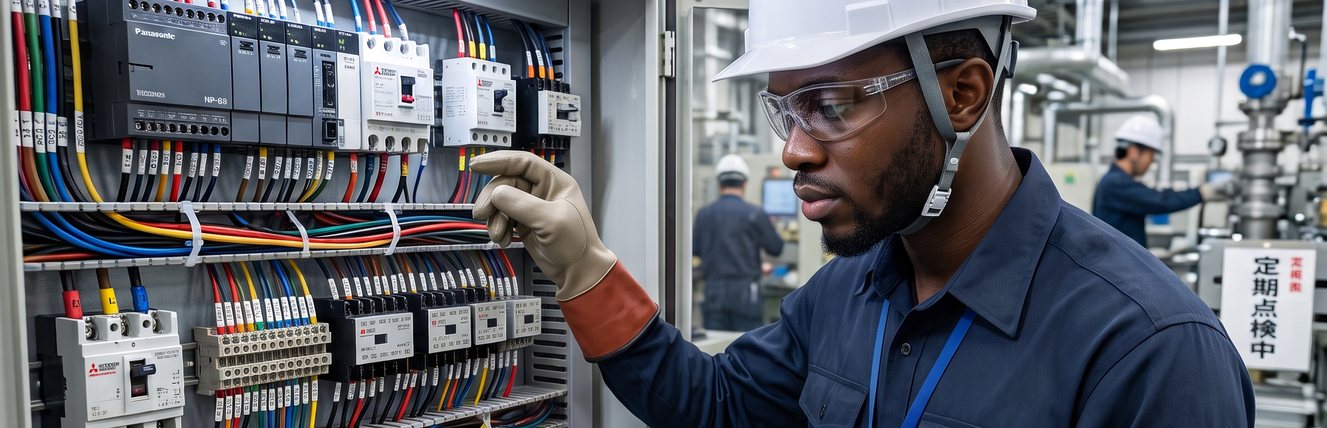
Where the line actually is
Under the Electricians Act (電気工事士法), any work on the fixed installation — the wiring inside the walls and everything permanently connected to it — must be carried out by a licence holder. For a normal home, that licence is the Class-2 electrician licence, 第二種電気工事士.
It is not a formality. It is the reason an insurer, a landlord or a buyer can ask who did the work.
What you can do yourself
- changing a bulb, or a whole light fitting on a standard ceiling rose (引掛シーリング) — it unplugs and plugs back in;
- plugging in anything with a plug, including an extension lead;
- resetting a tripped breaker;
- replacing the batteries in a smoke detector.
What you may not
- replacing a socket or a wall switch, even identically;
- adding a socket, a circuit or a dedicated line;
- wiring a light fitting directly instead of using the rose;
- anything at all inside the distribution board (分電盤);
- connecting an air conditioner's indoor and outdoor units.
The three ways it goes wrong
Unlicensed work in a rented Japanese flat has three predictable consequences, and they tend to arrive together:
- Insurance. Fire insurance can refuse a claim traced to work done without a licence.
- The move-out bill. Your landlord or 管理会社 can require the flat to be restored (原状回復) at your expense.
- The hidden risk. A badly reconnected socket does not fail immediately. It heats up quietly inside a wall for months first.
When the breaker keeps tripping
Before assuming a fault, look at your contract. Japanese homes are supplied under a contracted amperage (契約アンペア) — often 30 A in an older flat — and a microwave, a kettle and a hairdryer together will exceed it. Raising the contract to 40 or 50 A is a request to the power company, not a repair.
If the breaker trips with almost nothing running, that is different, and it should be looked at.
What to ask for, whoever does the work
Ask for the name of the licence holder who did the work and an invoice describing what was done. It costs the electrician nothing to provide and it is exactly what an insurer or a landlord will ask you for later.